Blog 6: Elemental Edo II: Water

Print #46 Yoroi Ferry, Koami-cho,

Hiroshige included water — canals, moats, streams and rivers — in no fewer than 91 of his 118 prints in the 100 Famous Views of Edo series. So ubiquitous was water on the Edo landscape that early western visitors compared the city to Venice. In addition to the aesthetic value of waterways that Hiroshige depicted, water played a starring role in the development of Edo.

The print above depicts a woman waiting for a ferry to cross Nihonbashi River. Distinctive white storehouses lining the waterway kept staples such as rice, soy sauce and sake after boats transported them to the capital. That location today is close to the Tokyo Stock Exchange.

Transportation

A river-canal-moat network engineered to the outer perimeters of Edo Castle created transport within Edo, bringing immense timbers and massive boulders to Edo to construct the castle and its moats. Print #45 below shows a junction of Nihonbashi River with Edo Castle’s moat system through which the timbers and hewn rock passed.

The bridge is called “Yatsumi no Hashi” which means “an eight bridge view,” noting the many bridges visible from that spot (only three of which can be seen from the picture). The calm of the print’s summer day masks the frenzy of what was one of Edo’s busiest spots. A signboard still remains here from the Edo Era on which parents posted notices to find children they had lost in the press of the crowds. In the very bottom left of the print you can see the hats of two pedestrians as they crossed the bridge.

Print #45, Yatsumi Bridge. Edo Castle and Mt. Fuji are in the background

Defense

Soon after Tokugawa Ieyasu declared Edo his capital in 1603, he excavated moats to defend Edo Castle. Rather than using only one or concentric circles for moats, Ieyasu innovated with a system using a spiral design (see image below) to confuse potential invaders with its asymmetry. Although many have been destroyed, the moats encasing today’s Imperial Palace remain a beautiful and distinguishing characteristic of central Tokyo.
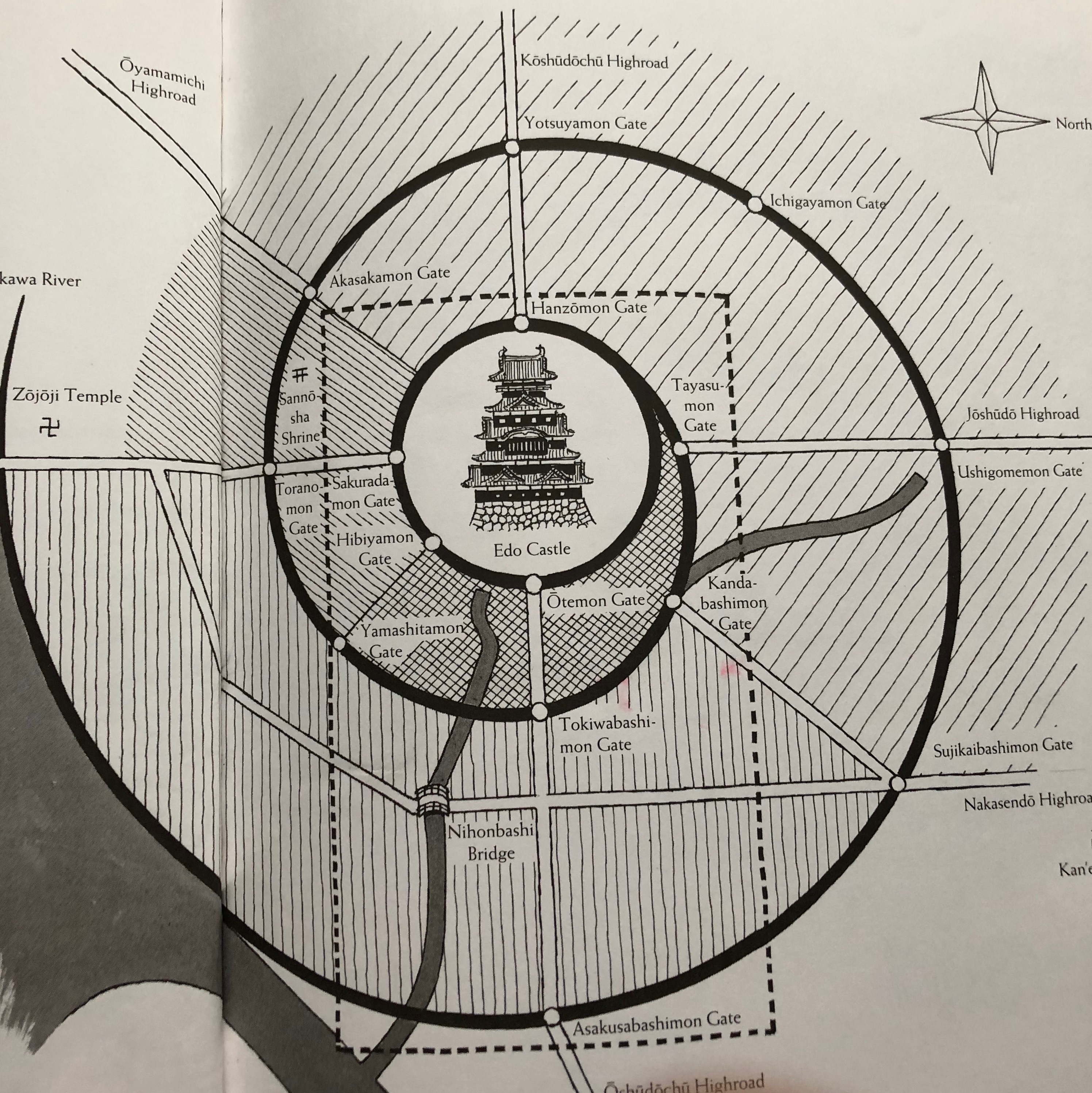
The thick black lines are the spiraling moats. [1]

Spiritual Release, Amusement, and Lettered Activities

Waterways and their banks also provided respite from the unrelenting control of the shogunate. Shrines and temples clustered along waterways offered spiritual release and became magnets for entertainment from puppet shows to jugglers, magicians and other midway fare, as well as prostitution. These waterside areas also created literary spaces in Edo where kabuki and other kinds of storytelling, theater, and lettered activities flourished [2].

Drinking Water

Water was not always Edo’s friend. Marshy fields at the mouth of a sea inlet filled most of its wells with brackish, undrinkable water. And the web of streams and rivers flowing through the lowland areas were constantly flooding.

The simultaneous problems of both too much and too little water caused Tokugawa Ieyasu and his successors to undertake ambitious engineering feats to bring potable water into the city and redirect flooding waterways away from the lowlands. The engineering began with digging a series of wells throughout the city, then building wooden pipes to bring fresh water to the wells.[3]

A Water System

Print #87, Benten Shrine at Inokashira Pond

To meet the demands of a fast-growing population, the shogunate tapped a water source at Inokashira (above) that at that time was in a town about eight miles west of Edo Castle and today is in western Tokyo. The literal meaning of Inokashira is “head of the well.” Engineers built a canal and a man-made river called Kandagawa River to bring the water to central Edo. Hiroshige’s print below is a view of this river whose steep banks still create striking views as one takes the Chuo Train Line west from Tokyo Station.

Print #47, Seido and Kanda River from Shohei Bridge

By the mid 1700s water pumped to the city center via the Kandagawa was no longer sufficient, and the third Tokugawa shogun undertook a comparable project in the south that linked with the Kandagawa.[3] Print #42 below depicts people enjoying cherry blossoms on the canal importing water from the Tama River to the southern portion of Edo.

Print #42 Cherry Blossoms on the Banks of the Tama River
( Although that’s the print’s title, it’s actually the canal to the Tama River.)

Reclaiming its Watery Past

After Edo became Tokyo in 1868, waterways were sacrificed to development. But the city once again seems to be embracing its watery heritage. Some rivers that had been routed underground have allowed to resurface, and walking paths have sprung up along the Sumida and other rivers and streams.

The Edo-Tokyo App will guide you to a number of strolls along these waterways. Inokashira Park in western Tokyo remains a great retreat from the city within the city, replete with boating. It can be handily combined with a visit to the nearby Ghibli Museum (reservations required) featuring the anime of Miyazaki Hayao.

The Tokyo Waterworks Historical Museum near Ochanomizu Station is a hidden gem of a museum that tells the drama of Edo-Tokyo and its water. Although its English signage was not complete when I last visited the museum, exhibits, pictures and animation more than compensate to graphically tell the story of water in Edo.

[1] Akira Naito, Edo the City that Became Tokyo, An Illustrated History, with illustrations by Kazuo Hozumi, translated by H. Mack Horton, Kodansha International, 2003, pps. The map is reproduced from pages 34-45. The original was published in Japanese by Soshisha under the title Edo no Machi in 1982.

[2] Hidenobu Jinnai, The Spatial Structure of Edo, Chapter five in Nakane Chie and Shinzaburo Oishi, The Social and Economic Antecedents of Modern Japan, University of Tokyo Press, 1990.

[3]The website:  http://www.us-japan.org/edomatsu/josui/frame.html provides terrific information about building Edo’s water system as well as many other aspects of the Edo Era.

Blog #5: Elemental Edo 1: Earth

This blog entry is the first of three that will focus on the elements that shaped early Edo in the 1600s, the landscapes that Hiroshige drew in the 1850s, and the layout of Tokyo today.

Tokyo is positioned on Japan’s major island of Honshu that stretches about the length of California, two-thirds of the way up the winding eastern seacoast. Why there?

The story of Tokyo’s location begins with three successive feudal warlords who fought in the 16th century to wrest control over warring fiefdoms that had embattled the country for a century and a half. To distinguish these three founding warriors, Japanese schoolchildren recite a jingle that answers a Zen master’s question about what each warrior would have done if a nightingale had alighted in its garden but failed to sing.

The first, Oda Nobunaga (1534-1582), brutal but beloved for his idiosyncratic fashions and far-ranging interests, would have killed the nightingale. The second, Toyotomi Hideyoshi (1537-1598), would have slyly coaxed the bird to sing. The third, Tokugawa Ieyasu (1543-1616), would have waited patiently for the nightingale’s song. It is thanks to this patience that Tokyo is located where it is.

When the sly and coaxing warrior Toyotomi Hideyoshi was in ascendance, Tokugawa Ieyasu provided him battle assistance that resulted in a decisive victory. In gratitude, the wily Toyotomi offered Tokugawa a huge tract of land in the marshy, eastern wilderness of Japan in return for Tokugawa’s far smaller but much more strategic family holdings in the country’s center.

Much to the shock of everyone, Tokugawa Ieyasu accepted this seemingly bad deal and moved with his troops to this eastern area — well known for its natural beauty through many literary allusions, but also synonymous with the end of the world. On this eastern edge of the Kanto Plain (at that time called the Musashi Plain), at the marshy, weedy mouth of an inlet that protruded inland from the northern reaches of Edo Bay, sat a tiny fishing village called Edo, whose name means “entry to the Bay.”  It was here that Tokugawa Ieyasu took his troops to bide their time.

A warrior poet named Ota Dokan had, over a century before, built a wooden fort at this spot that now sat in a state of disrepair. One of his poems captures the landscape:

The abode of mine/Adjoins a pine grove/Sitting on the blue sea/And from its humble eaves/Commands a view of soaring Fuji.

Edo, like Rome, was built on five hills. Within several miles north and south of Ota Dokan’s fort, five highland fingers on Musashi Plan separated lowland valleys where rivers and streams flowed into Edo Bay.

The device to visualize Edo-Tokyo topography is to picture your left hand with fingers pointing to the right. The five highland areas, starting with your little finger moving downward toward the thumb are: Ueno, Hongo, Kojimachi, Azabu, and Shinagawa Plateaus.

I’ve selected prints that show Edo’s topography in both the north (on the left) and the south (on the right) of the city.  Suwa Bluff at Nippori (print #17 above on the left) depicts a cherry blossom-viewing scene in the Ueno highlands, where villagers climbing up the escarpment in the center show its steep pitch.  Hiroo on Furukawa River (print #22 on the right) between the Azabu and Shinagawa Plateaus shows a more rolling, hilly landscape in the southern part of Edo

Tokugawa Ieyasu and his warriors refurbished and expanded Ota Dokan’s fort (located between your ring and middle fingers), cleared the reeds, and went about building this settlement until after Toyotomi Hideyoshi died and national supremacy was once again a fighting matter. 

Tokugawa Ieyasu and his warriors left this isolated refuge to fight the Battle of Sekigahara in 1600. They emerged victorious, and three years later the Emperor in Kyoto declared Tokugawa Ieyasu shogun (roughly translatable to “generalissimo”) of the newly united Japan, and he in turn declared that Edo would be his capital.

Tokugawa Ieyasu used Edo’s natural landscape to build a capital designed for defense. Rather than demolish the hills and bluffs to create a grand layout like the grid of Kyoto, which in turn was patterned on Beijing, he built approaches to the castle that followed the land’s natural contours along stream and animal paths. In this way, enemies desiring to attack the castle would be required to spend important time navigating curlicue routes to reach the castle rather than advancing directly to a point on a grid.

Even after Edo became Tokyo in 1868 and was twice leveled by earthquake and bombs, the brilliant architectural historian Jinnai Hidenobu describes that much of Tokyo and its streets have largely retained their original routes following natural land contours[1]. Tokyo has never had its Baron von Haussmann who “rationalized” the Paris city center or city planners who completely overwrote nature’s own blueprint.  So, as you wander in Tokyo hopelessly lost among its winding streets in their plate-of-spaghetti-like layout, a measure of consolation may lie in knowing that Tokugawa Ieyasu would be smiling and murmuring to himself, “mission accomplished.”


[1] Jinnai, Hidenobu, Tokyo, a Spatial Anthropology, translated by Kimiko Nishimura, University of California Press, 1995.

Blog #4: A Glimpse of the Flourishing Artist?

The City Flourishing, The Tanabata Festival, Print # 73 from Hiroshige’s “100 Famous Views of Edo”

Red and yellow papers with wishes written in calligraphy, a miniature abacus, sake flask, and gourd, an account ledger, watermelon slice, a paper fish and fishnet — all dancing on feathery bamboo branches in the summer wind.

Edo residents looking at this print would recognize the bobbing items as ornaments for the annual Tanabata festival, marking the one day each year when two stars, mythical lovers, are allowed to cross the Milky Way to embrace. As familiar as the symbols were to Edo residents, this print is notable as the sole landscape among 118 prints in the 100 Famous Views of Edo whose location is ambiguous.

The view was likely from the veranda of Hiroshige’s second story workshop, perched above his house, looking out into the summer sky[i]. In the very bottom right corner a drying summer kimono flaps in the wind — perhaps it’s Hiroshige’s. The pictured flask is an apt symbol for this artist known to enjoy sake.

Looking up and to the left from the kimono, above the roof cornice, a brown stick-like fire tower stands near Edo Castle. This fire tower marks the spot where Hiroshige was born in 1797 into a firefighting samurai family with hereditary responsibility to protect Edo Castle from flames.

The Flourishing City leaves the interested viewer with many questions: Is it really Hiroshige’s house? Did he purposely, perhaps with a smile, sketch a glimpse of his drying kimono and favorite sake flask? What was he thinking as he drew the fire tower from his youth into this print?

Although only about half a mile separates Hiroshige’s two-storied home from the fire barracks where he was born, the years in between covered bumpy territory for this artist known as good-humored, reliable, and an enjoyer of good food and sake[ii]. Hiroshige’s life landmarks include:  

  • Suffering early losses of an older sister at age three, and his mother and father just months apart when he was 12
  • Assuming family leadership for the fire brigade at age 12
  • Earning a commendation for his firefighting
  • Renouncing samurai rank and firefighting responsibilities, and with it, his Shogunal stipend, at age 26 (1823) to attempt a living as a print designer
  • First making a name for himself with the 53 Stations of the Tokaido series published in 1833-34
  • Losing his first wife, who had secretly sold her clothes to help finance his art[iii], in 1839 
  • Never missing a deadline while publishing over 8,000 lifetime prints
  • Designing multiple series of Edo prints before undertaking 100 Famous Views of Edo
  • Borrowing money n 1849 to build the house whose view is likely portrayed in Flourishing City to live with his second wife, Oyasu, whom he had married two years earlier
  • Shaving his head and becoming a Buddhist monk in 1856

Hiroshige died at age 61 in a cholera epidemic 15 months after designing Flourishing City, making the 100 Famous Views of Edo series his final; an acolyte, Hiroshige II, actually finished a few prints in this series. Flourishing City inspires questions about Hiroshige’s art and life, and the relationship between them.

Art historians provide sociological, economic, and historical perspectives on Hiroshige’s art; future blogs will explore some of these clever and interesting theories. But a clear vision of Hiroshige’s inner landscape, the generator for the sparks of his creativity that kept rekindling over his lifetime, the psychological framework, is as lost as his detailed personal diary that went up in flames in an 1876 fire[iv].  In the same way that Flourishing City invites conjecture about the artist’s relationship to that print, we can only surmise how the events of Hiroshige’s life unfolded into his art.

I like to think that Flourishing City, airy, colorful and perhaps playful, is also about the artist flourishing. In the distance between his birth and his 60-year-old self he had survived multiple losses and achieved a second marriage; he had given up the fire tower of his birth for his second story workshop that afforded an equally fine view; he had passed his 60th birthday that marks a rebirth in Japanese culture; and although not a wealthy man, it was with pride that Hiroshige penned a note to repay his debts just before his death fifteen months later.

A Note on the Locations of this Print

Tokyo Station is close to a center point between the sites of Hiroshige’s birthplace and his final home. The site of the fire tower is a ten-minute walk from the West (Marunouchi) Exit of Tokyo Station where the staid and imposing Meiji Life Insurance Building marks the spot today. The site where Hiroshige lived in his final years is about a ten-minute walk from the East (Yaesu) Exit of Tokyo Station.

A modest metal marker mounted on a pole in front of a bland commercial building at 9-7 Kyobashi 1-chome marks the site of Hiroshige’s final home. However disappointing this reminder of Hiroshige, his spirit remains in the neighborhood. After many travails finding the marker and wanting to linger in the neighborhood, I wandered into a nearby shop selling knives. The shopkeeper told me that he was the fifth generation of his family to run the shop and that his great grandfather had been Hiroshige’s friend. This “find” more than compensated for the mundane sign marking the spot of this exquisite print.


[i] For example, one of the most historically precise books about this series, Hiroshige, One Hundred Famous Views of Edo, with commentaries by Henry D. Smith III, simply assumes the view is from Hiroshige’s home.

[ii] Character traits described, for example, by Oka Isaburo in Hiroshige, Japan’s Great Landscape Artist (Kodansha International, New York, 1992) page 62 and Richard Lane in an essay on Hiroshige in Hokusai and Hiroshige (“Ukoyo-e”/Garunde, Tokyo 1976), pps. 6 & 7.

[iii] As told by Noguchi, Yone, Hiroshige, (Forgotten Books, 2012, originally published in 1912).

[iv] Referred to by Oka Isaburo (ibid) page 69.

Blog #3: A City Suspended in Motion

Hibiya and Soto-Sakurada from Yamashita-chō, Print #2 from Utagawa Hiroshige’s “100 Famous Views of Edo”

This is another New Year’s landscape. Only a ten minute walk east from the New Year’s early morning in Kasumigaseki (Blog #2), this view faces away from Tokyo Bay in the opposite direction, to the southwest and the sacred Mount Fuji.  

The decorated boards framing both sides of the print are paddles for the New Year’s battledore shuttlecock game played by women and girls. The feathered shuttlecock is suspended in mid-air above and between them. Boys are flying kites and a victory is apparent in the tangled strings where one kite has taken down its competitor. The pine decoration on the bottom left rounds out the New Year’s imagery.

Kites with Legs and a Topsy-Turvy Social Order

A kite in the shape of a samurai’s footman (a yakko kite),with legs dangling into view in the print’s upper center above the shuttlecock is the element in this landscape that most sparks my imagination. Commoners and low-ranking samurai of this era enjoyed flying such footman-shaped kites high above the homes of their social superiors.[i]

The Tokugawa shogunate that ruled Japan from Edo Castle between 1603 and 1868 prescribed a rigid social hierarchy. This ranking placed warriors at the top of the social ladder. Merchants were relegated to the bottom rung because, in this Marxist-like notion, they were thought to produce nothing of value, in contrast to the farmers and artisans occupying the middle tiers.

By the time Hiroshige designed this print in 1857, merchants had grown in power and wealth while many members of the warrior class had become decidedly anachronistic. The ladder of power had flipped on its head.

Although the Tokugawa government took many steps to curtail and circumscribe the rising power of the merchant class, change was palpable and unstoppable, and the manservant kites flying high above the samurai residences reflected a social world, stopped momentarily in the freeze-frame of  this print, turning on its head.

From the Commoner’s Neighborhood to the Warrior Mansions

The scene is positioned from the commoner village of Yamashita-cho (present-day Sukiyabashi). It extends over the massive stones embanking Edo Castle’s moat on the right, past the mansions of the warriors and top retainers of the Shogun in the hills dotted with high fire towers, to the sacred Mt. Fuji some 80 miles to the southwest of Edo (Tokyo).

The red-gated mansion is home to one of the most powerful daimyo, the generic name for the approximately 200 feudal regional lords. The TokugawaShogunate required all daimyo to live in Edo with their families, allowing them, but not their wives and children, to return to their regional estates in alternate years.

Families that had fought with Tokugawa Ieyasu in the decisive 1600 Battle of Sekigahara lived, like this daimyo, either inside or close to Edo Castle, while those who opposed him were relegated to the outer reaches where they could be more easily contained in case of rebellion. This system of residential placement as well as the method of holding families hostage in the capital while the daimyo lords returned to their land were but two of many methods of social control.

The red-gated mansion is in today’s Hibiya Park, visible in the Blog 2 map as the green swath on the southeast corner of the ImperialPalace. The Imperial Hotel (one version of which was designed by Frank LloydWright in the late 1880s) is an iconic Tokyo landmark. If it had been built in1857 when Hiroshige designed this print, it would be just behind the pine in the print’s bottom left corner.

The stones in the moat’s embankment are also iconic in today’s Tokyo. This particular section of moat has been filled in, but impressive stone embankments still encircle the nearby Imperial Palace. The massive stones were quarried on the Izu Peninsula south of Tokyo, brought to Edo by boat, pulled through the town over seaweed skids, and positioned in the defensive walls by master engineers. Some of their chiseled signatures from the early1600s remain visible in sections of the moat.

Was Hiroshige musing on this New Year’s Day about the future of Edo, whether the long-standing stability of the moat’s stone walls would prevail?  Or perhaps the winds of change when a servant could fly above warriors’ homes was a presage of things to come? Or was Hiroshige simply capturing a gorgeous view of a scene well known to Edo dwellers on a holiday morning?

A Cinematic and Culinary Aside

Jiro Dreams of Sushi is a totally charming 2011 documentary about the sushi chef Jiro Ono whose restaurant is located in Sukiyabashi, the present-day location of this print. As the restaurant has three Michelin stars and only ten counter seats, reservations are a bit hard to come by. President Obama, for example, enjoyed a meal there, though there’s some controversy about whether he finished everything. Jiro’s son has opened a two star Michelin, Sushi Jiro Roppongi, said to be equally delicious and a touch more accessible.


[i] H.Utagawa , One Hundred Famous Views of Edo,

Published by the Tokai Bank Foundation, Shigemitsu Miyake, Chairman

Blog #2: Happy New Year from Kasumigaseki, the Misty Checkpoint

Kasumigaseki, Print #2 from Hiroshige’s “One Hundred Famous Views of Edo”

This scene of early morning bustle on a New Year’s morning is one of two prints that Hiroshige drew of Japan’s premier holiday.

The slope is Kasumigaseki, whose literal meaning is “misty checkpoint.” Since medieval times Kasumigaseki was a guard station on a road leading to the north of Japan.

The print looks southeast from the Kasumigaseki hill crest in central east Edo (Tokyo), where the Shogun’s retainers lived behind the imposing walls on either side of the wide road in the foreground. A densely packed commoner neighborhood lies in the lowlands, and then the landscape opens to the expansive brilliant blues of the sea and sky over Tokyo Bay, as the sunrise projects hues from pink to startling red. Wisps of sailboats and kites soften the expanse.

Many of the best sushi restaurants in the U.S. import their fish from Tsukiji Market in Tokyo.  The very high roof that soars out of the commoner neighborhood (lower left quadrant, about a quarter of the way up the print) is the Tsukiji Honganji Temple, close to the original Tsukiji fish market. Though the wholesale fish market moved to another spot in 2018 — a must visit in Tokyo — the Tsukiji neighborhood in the vicinity of the Tsukiji Temple retains the best, amazingly fresh, sashimi in Tokyo.

Both the temple and fish market are stops on strolls in the Great Edo-Tokyo app my Japanese colleagues and I are developing, as is the Kasumigaseki neighborhood.

Holiday Imagery and Fan Entrepreneurship

Japanese people looking at this print instantly understand it’s New Year’s. The pines in front of the gate on the left are New Year’s ornamentation; men carrying a decorated pole in the center foreground are street performers; a pair of comedians to their left go from house to house singing songs; the man on the left with trays stacked high is delivering sushi; the flying kites in the sky and the paddle carried by the girl pictured with her mother are features of New Year games; and the procession ascending the hill are samurai who likely paid early morning respects at Edo Castle.

My favorite New Year’s character is the man on the right with a backpack.  Fans are a traditional New Year gift, and this entrepreneur goes house to house buying up unwanted New Year’s fans to sell at deep discount, perhaps for giving the next year. Clever recycling!

Edo-Tokyo Topography 1: Orienting from The Imperial Palace and the Sumida River

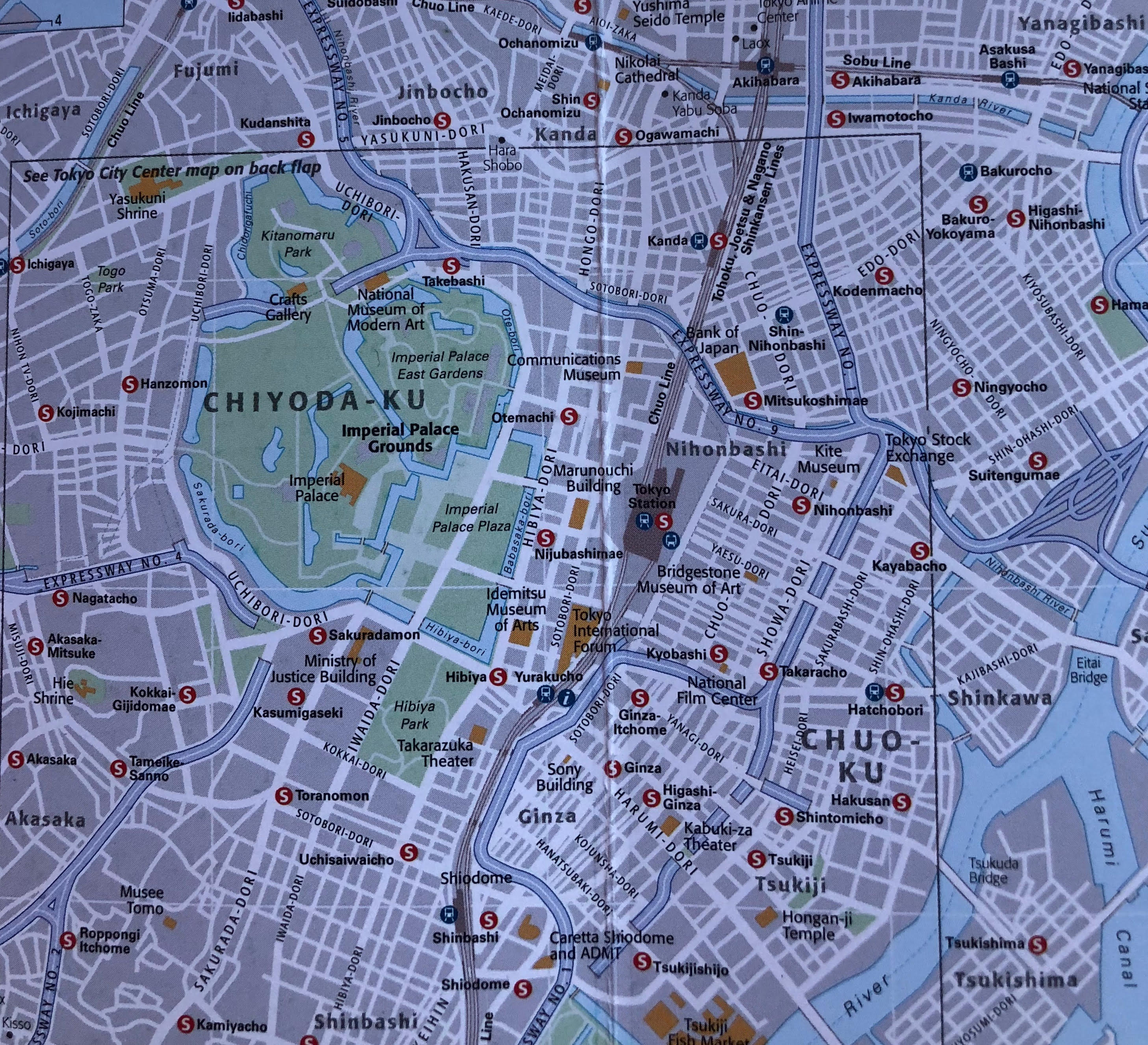
Two geographic features help establish a sense of place in Tokyo: position relative to the Imperial Palace and to the Sumida River. Below is a map[i] where the large swath of green marks the grounds of the Imperial Palace (home of the Emperor) and the stretches of blue on the far right denote the Sumida River that flows into Tokyo Bay  (just out of sight to the south).

Kasumigaseki is south of the Imperial Palace and west of the Sumida. In this map it appears below the label, “Imperial Palace,” and “Ministry of Justice Building.”

Kasumigaseki, From Poetry to Bureaucracy

With a name as poetic as “Misty Checkpoint,” it’s not surprising that Kasumigaseki has appeared in many poetry volumes over the years. It has other, very different connotations as well.

Japan’s Foreign Ministry is located at Kasumigaseki. In the years before World War II, Washington diplomats often simply called the Japanese Foreign Ministry “Kasumigaseki.”  In an odd coincidence of names, this meant that Foggy Bottom (a moniker for the US State Department) was negotiating with Misty Checkpoint in the prewar years. No wonder it didn’t go well with so much condensed moisture impeding vision on both sides!

The Kasumigaseki Building located here was Japan’s first high-rise that could exceed an 11-story limit enforced until architectural technology allowed higher buildings to withstand earthquakes. Built in 1968, the 36-story Kasumigaseki Building was one of the symbols marking Japan’s re-entry on the world economic stage after World War II.

Today Kasumigaseki often evokes the tens of thousands of grey-suited government bureaucrats who pour out from the Kasumigaseki subway station each day to work in the many surrounding government buildings, only to file back in when the day is done.

Amid thickets of buildings far higher than the Kasumigaseki Building that obscure the sightline to Tokyo Bay for the New Year’s sunrise, many interesting and historic sites dot the “Misty Checkpoint” neighborhood. The Great Edo-Tokyo App will guide you to them.


[i] Map copied from Eyewitness Travel, Top 10 Tokyo

Blog #1: The Test Balloon

This blog will complement, and hopefully increase your enthusiasm for the Great Edo-Tokyo app that I am creating with colleagues in Japan. The App will use wood block prints from Hiroshige’s 100 Famous Views of Edo series (Edo is the old name for Tokyo) in a dozen or more guided walks in different Tokyo neighborhoods.

Tokyo was leveled in the Great Kanto Earthquake of 1923, flattened again by bombing in 1945, and has passed through successive waves of extraordinary modernization. One upshot is that, unlike some European capitals where history is palpable, casual visitors to modern Tokyo can miss some of its history and embedded culture that are so unlike other world cities. One goal of this App is to go below the modern surface to bring some of Tokyo’s unique history, historical characters, and culture alive.

As an example: Hiroshige designed this landscape of wisteria cascading from an arched bridge on the grounds of Kameido Shrine, one of my favorite prints from the series. People today still flock to this shrine for wisteria viewing, just as they did when Hiroshige designed the print in 1857.

So this shrine, with Hiroshige’s print and information about it, will be one stop on a guided neighborhood walk.  Even if the wisteria aren’t in blossom when you visit Kameido Shrine, stop to watch the turtles basking in the ponds, enjoy the quiet, and rub a cow’s head for academic success.

The Blog will pull together three different threads relevant to the App.

The App Itself

We’re aiming to have the App available for visitors to Tokyo for the 2020 summer games. My colleagues in Tokyo are busy adding content and developing the tech infrastructure for it. A friend from Japanese class and I are translating it into English, and there are plans to translate it into Chinese as well. With funding from the Japanese Ministry of Culture we think it will be feasible to add Augmented Reality. I’ll talk more about this later, as well as share progress on the App.

Bringing Tokyo History Alive

Tokyo developed when Japan was largely cut off from the western world for 250 years, and even today is arguably the world’s least well known major capital. The App and this Blog will touch on some of the fascinating history of Edo-Tokyo that makes it such a distinctive city with a deep culture. We will look at some of the back stories behind aspects of modern Japanese culture, from sushi to manga to couture, to answer such questions as:

  • Why did sushi become so popular in Edo’s (Tokyo’s) in the 1600s?
  • Why is it so damnably easy to get lost in Tokyo (Hint: It was planned that way.)
  • Why did early western visitors to Edo (Tokyo) compare it to Venice?
  • What connects the emblem for the 2020 games (below) with with a  popular actor from the 18th century?

The Wood Block Prints and Hiroshige

Hiroshige’s 100 Famous Views of Edo series depicts landscapes that would have been known to all Edo residents when Hiroshige drew them in the late 1850s. Each of the guided strolls contains at least one of the 118 prints.

The prints themselves are also a fascinating story. Although they are treasured in museums today, many sold for the price of a couple bowls of noodles in Hiroshige’s day. This Blog will tell some of the magic of these prints, how they developed in a city largely isolated from the rest of the world, were “discovered” in Paris, and went on to have  profound world impact.

Hiroshige himself was an Edo native, a samurai whose first career was firefighting. The story of how he became a print master is deeply intertwined with the history of Edo-Tokyo and the earthshaking times in which he lived. The prints and their artist will be part of the story as well.

This Blog will be fun to write, and I welcome any and all comments about what would be interesting to you.